Angiogenesis
Angiogenesis is the process by which new blood vessels grow from existing ones. It is an ubiquitous phenomenon in health and disease of higher organisms, playing a crucial role in organogenesis, wound healing, inflammation, as well as on the onset and progression of over 50 different diseases such as cancer, rheumatoid arthritis and diabetes. We develop mathematical models of angiogenesis that characterise the bio-mechanical processes driving endothelial cell proliferation, neo-vascular network development and morphology, and predict tissue irrigation.

- Intratumoral VEGF nanotrapper reduces gliobastoma vascularization and tumor cell mass, Flávia Sousa, Ana Isabel Costa-Pereira, Andrea Cruz, Fábio Júnio Ferreira, Marcos Gouveia, José Bessa, Bruno Sarmento, Rui DM Travasso, Inês Mendes Pinto, Journal of Controlled Release, 339, 381-390 (2021).
- Angiogenic factors produced by hypoxic cells drive anastomoses in sprouting angiogenesis – a computational study, Maurício Moreira Soares, Rita Coimbra, Luís Rebelo, João Carvalho, Rui D.M. Travasso, Scientific Reports, 8, 8726 (2018).
- The Force at the Tip – Modeling Tension and Proliferation in Sprouting Angiogenesis, Patrícia Santos-Oliveira, António Correia, Tiago Rodrigues, Teresa M. Ribeiro-Rodrigues, Paulo Matafome, Juan Carlos Rodríguez-Manzaneque, Raquel Seiça, Henrique Girão, Rui DM Travasso, PLoS Comput Biol, 11, e1004436 (2015).
- Tumor angiogenesis and vascular patterning: a mathematical model, Rui DM Travasso, Eugenia Corvera Poiré, Mario Castro, Juan Carlos Rodríguez-Manzaneque, A. Hernández-Machado, PLoS ONE, 6, e19989 (2011).
Tumor growth
We develop cell based models that explore bio-mechanical processes in tumor development. We have a strong focus on urothelium cancer, where we find that the position of initial lesion in the urothelium strongly determines tumor progression and its invasiveness.
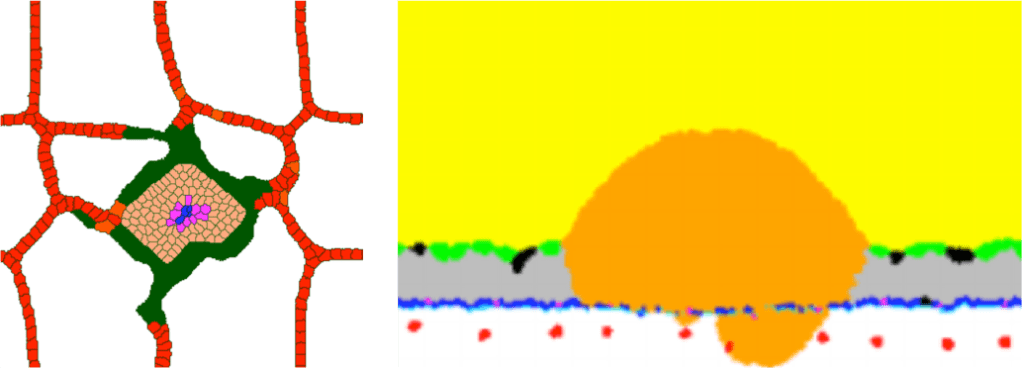
- A multiscale cell-based model of tumor growth for chemotherapy assessment and tumor-targeted therapy through a 3D computational approach, Sahar Jafari Nivlouei, Madjid Soltani, Ebrahim Shirani, Mohammad R. Salimpour, Rui D.M. Travasso, João Carvalho, Cell Proliferation, 55, e13187 (2022).
- A three dimensional computer model of urothelium and bladder cancer initiation, progress and collective invasion, Joao Carvalho, Valeria Lopes, Rui Travasso, Informatics in Medicine Unlocked, 26, 100750 (2021).
- Multiscale modeling of tumor growth and angiogenesis: Evaluation of tumor-targeted therapy, Sahar Jafari Nivlouei, M. Soltani, João Carvalho, Rui DM Travasso, Mohammad Reza Salimpour, Ebrahim Shirani, PLoS Computational Biology, 17, e1009081. (2021).
- Tumor cell invasiveness in the initial stages of bladder cancer development‐A computational study, João Carvalho, Valéria Lopes, Rui DM Travasso, International Journal for Numerical Methods in Biomedical Engineering, 37, e3417 (2021).
- Cell Reversal From a Differentiated to a Stem-Like State at Cancer Initiation, João Carvalho, Frontiers in Oncology, 10, 541 (2020).
Single cell modelling
Cells migrate, deform and adhere to each other. These alterations in cell shape are the result of concerted polymerisation and depolymerisation events of cytoskeleton fibres, as well as forces between cells and the extracellular matrix fibres and with other cells. We use mathematical modelling to explore the strategies of cell migration, the forces exerted between cells as well as intermediate filaments dynamics.
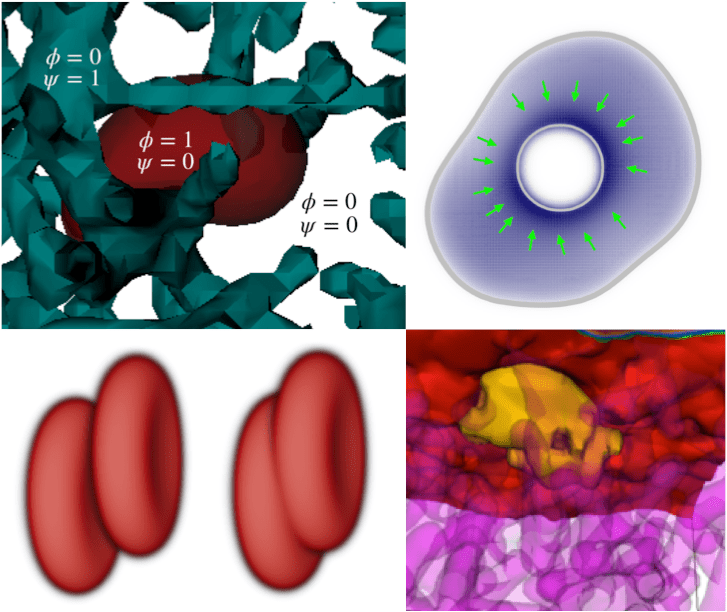
- Modeling the effect of substrate topography on cellular and nuclear deformations, Ana Bensabat, Marcos Gouveia, Claire Leclech, João Carvalho, Abdul I. Barakat, Rui DM Travasso, Computers in Biology and Medicine, 204, 111536 (2026).
- The ECM and tissue architecture are major determinants of early invasion mediated by E-cadherin dysfunction, Soraia Melo, Pilar Guerrero, Maurício Moreira Soares, José Rafael Bordin, Fátima Carneiro, Patrícia Carneiro, Maria Beatriz Dias, João Carvalho, Joana Figueiredo, Raquel Seruca, Rui DM Travasso, Communications Biology, 6, 1132 (2023).
- A mathematical model of fibrinogen-mediated erythrocyte–erythrocyte adhesion, Catarina S. Lopes, Juliana Curty, Filomena A. Carvalho, A. Hernández-Machado, Koji Kinoshita, Nuno C. Santos, Rui D. M. Travasso, Communications Biology, 6, 192 (2023).
- Keratin dynamics and spatial distribution in wild type and K14 R125P mutant cells – a computational model, Marcos Gouveia, Jure Derganc, Biljana Stojković, Marko Vidak, Špela Zemljič-Jokhadar, Rui Travasso, Mirjana Liović, International Journal of Molecular Sciences, 21, 2596 (2020).
- Adhesion modulates cell morphology and migration within dense fibrous networks, Maurício Moreira-Soares, Susana P. Cunha, José Rafael Bordin, Rui D. M. Travasso, J. Phys.:Condens. Matter, 32, 314001 (2020).
Bioelectricity
It was found that cell proliferation is correlated with its bioelectric state, in particular with the electric potential across the cell membrane. Cancer initiation may then depend directly or indirectly on bioelectric signals propagation throughout a tissue, mediating tumor cells’ membrane depolarisation. Computational modelling of this mechanism may permit the development of new preventive strategies to hinder tumor initiation.

- A computational model of cell membrane bioelectric polarization and depolarization, connected with cell proliferation, in different tissue geometries, João Carvalho, Journal of Theoretical Biology, 557, 111338 (2023).
- A Bioelectric Model of Carcinogenesis, Including Propagation of Cell Membrane Depolarization and Reversal Therapies, João Carvalho, Scientific Reports, 11, 13607 (2021).
 CFisUC: Soft and Biological Matter